NHTSA Proposes Cyan Marker Lights as the $108 Standard for Robotaxis
Federal regulators aim to standardize the visual language of autonomous vehicles by mandating a specific blue-green hue to distinguish driverless cars from human-operated traffic.
By Ananya Gupta ·
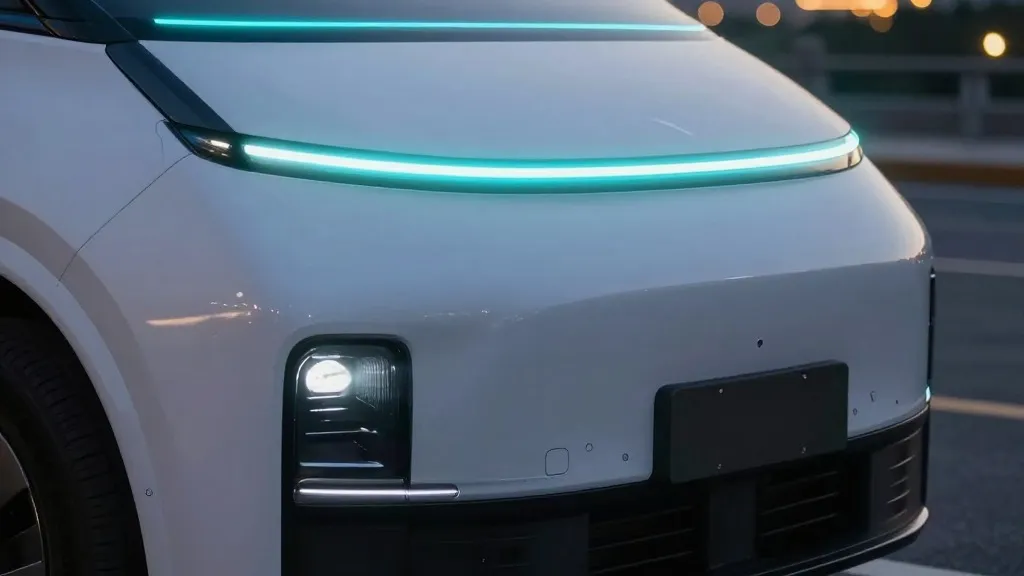
The long-standing debate over how self-driving vehicles should visually signal their autonomy status has reached a concrete regulatory endpoint. After years of industry fragmentation involving flashing text, audio cues, and bespoke lighting, the National Highway Traffic Safety Administration (NHTSA) has proposed a single, standardized visual marker: cyan. This move represents a significant shift in the Federal Motor Vehicle Safety Standard (FMVSS) No. 108, seeking to harmonize how autonomous vehicles interact with the broader traffic ecosystem.
The core of the proposal involves the addition of cyan-colored marker lamps designed to clearly indicate that an automated driving system is in control. The agency selected this specific blue-green hue because it occupies a visual gap in the current automotive lighting spectrum. Existing standards reserve red and amber for brakes and turn signals, white for headlights, and flashing blue or red for emergency vehicles. By introducing cyan, NHTSA aims to provide a distinct signal that law enforcement and other road users can recognize without confusion, filling a previously undefined segment of the color wheel.
While the proposal is not yet law, it establishes a national framework for major players in the autonomous vehicle market, including operators like Waymo, Nuro, and Zoox, as well as manufacturers such as GM and Mercedes-Benz. Although the use of cyan lights will be optional for manufacturers, the rule would strictly define their color, brightness, and placement. This standardization is intended to prevent a fragmented market where different companies use conflicting signals, thereby reducing cognitive load for human drivers sharing the road. Notably, Mercedes-Benz previously received state-level approval for similar turquoise lights for its Level 3 Drive Pilot system, though the automaker later shifted its strategy toward a Level 2++ system.
Beyond introducing new signals, the proposal seeks to streamline existing regulations that are ill-suited for driverless hardware. NHTSA intends to remove requirements for physical interior controls, such as hazard switches, manual beam shifters, and turn levers, which are redundant in vehicles operated by software. Additionally, the agency is updating the 12.8-volt testing standard to accommodate modern LED architectures, removing administrative hurdles that complicate the design process for autonomous platforms. The agency is also considering eliminating rules that dictate the physical positioning of high-beam lights relative to low-beam lights.
This regulatory update is part of a broader Department of Transportation initiative to accelerate the deployment of autonomous vehicles. By simplifying the compliance landscape, the government aims to make it more feasible for automakers to design vehicles without traditional human-centric controls like steering wheels and pedals. However, the path to a fully streamlined industry remains cautious. Last month, NHTSA initiated an audit query into the Tesla Cybercab to examine the technical data and certification process used by the company. The audit focuses on the vehicle's lack of traditional design features, such as sideview mirrors, pedals, and a steering wheel, which remain mandatory under current FMVSS interpretations.
The next phase involves public comment and final rulemaking, which will determine how quickly these standards can be implemented. For the autonomous vehicle sector, the clarity provided by a standardized cyan light could serve as a crucial benchmark for scaling operations, ensuring that the visual communication between machines and humans is as reliable as the software driving them.
Source: The Verge